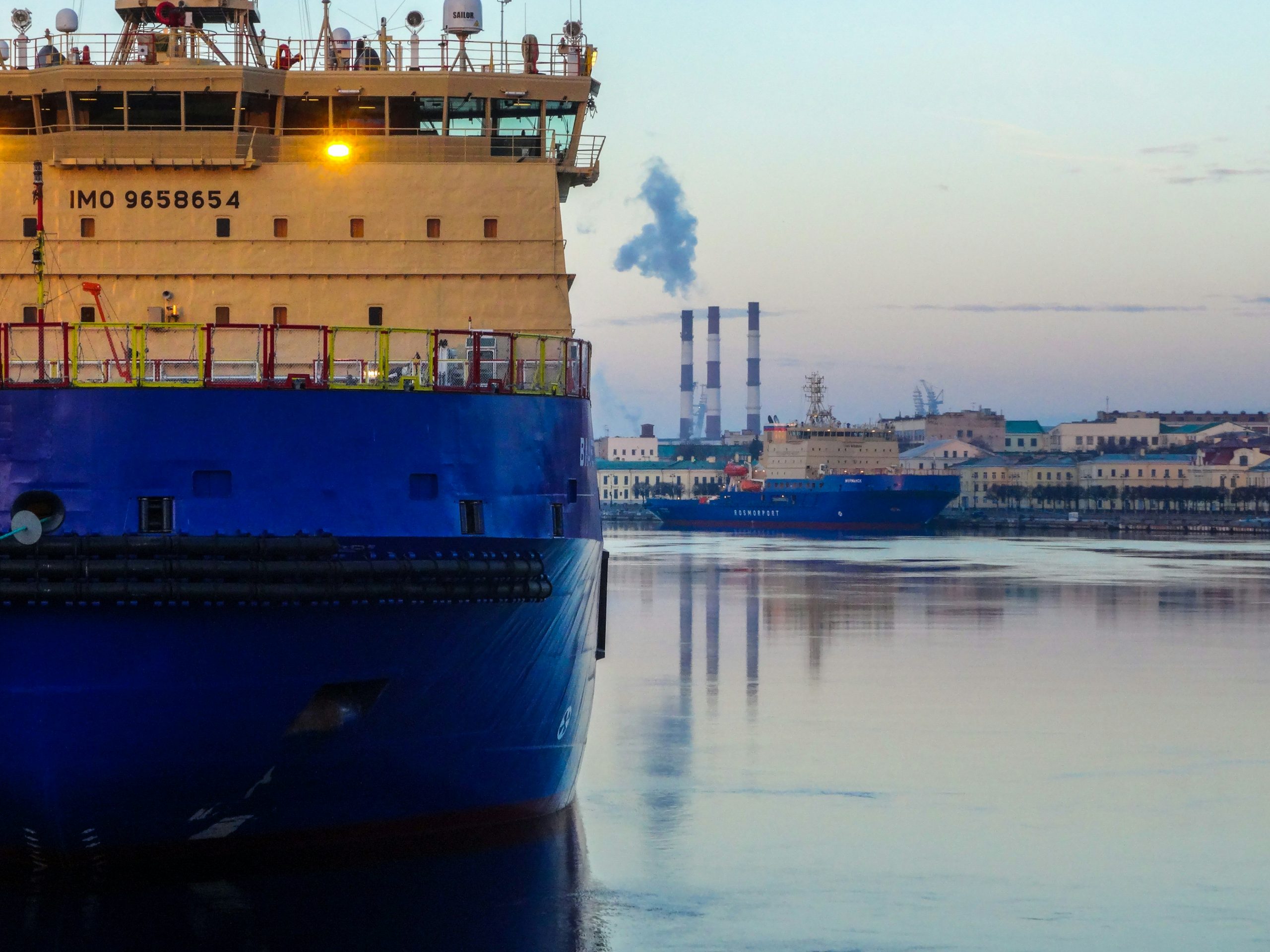
The shipping lanes around Greenland are strategically important because they sit at the junction between the Arctic Ocean and the North Atlantic.
This position places Greenland close to emerging Arctic routes while also overlooking established transatlantic trade corridors linking North America and Europe.
As Arctic ice retreats, maritime traffic between the Arctic and Atlantic is expected to increase, even if volumes remain modest in the short term.
Greenland also lies near the GIUK gap, a critical maritime chokepoint used to monitor naval and commercial movements.
Control and surveillance of this area matters for submarine detection, shipping security, and the protection of undersea cables carrying global data.
For the United States, influence over Greenland therefore strengthens both commercial resilience and military oversight of a vital oceanic crossroads.
Overseeing the increasing Arctic trade
Donald Trump’s interest in controlling Greenland can be partly understood through this strategic trade and competition lens.
While Greenland would not function as a conventional trade hub, it could anchor U.S. influence over future Arctic logistics, ports, and maritime governance.
This would help ensure that any growth in Arctic shipping develops under U.S.-aligned rules rather than those shaped by rival powers.
Trump’s transactional approach to geopolitics frames territory as leverage, particularly when it can constrain competitors’ trade options.
Russia and China
Limiting Russian and Chinese freedom of movement in the Arctic aligns with this thinking.
Russia relies heavily on the Northern Sea Route to export hydrocarbons and bulk commodities to Asian markets.
Greater U.S. presence around Greenland strengthens NATO’s ability to monitor Russian vessels moving from the Arctic into the North Atlantic.
This does not block Russian trade, but it raises the strategic and insurance costs of operating those routes.
China’s interests are different but equally significant.
Beijing views Arctic shipping as a way to diversify trade routes away from chokepoints like the Malacca Strait.
Chinese investment in Arctic ports, mining, and research infrastructure supports this long-term ambition.
U.S. control or dominant influence in Greenland would make it harder for China to convert investment into strategic trade leverage.
Commodity (lack of) availability
In trade terms, Greenland offers optionality rather than immediate economic windfalls for the United States.
The island is known to contain rare earth elements, iron ore, zinc, gold, and potentially oil and gas reserves offshore.
Rare earths attract particular attention because they are essential for electronics, renewable energy technologies, and defence systems.
Reducing dependence on Chinese rare earth supply chains is a core U.S. strategic objective.
The realities of extraction
However, the reality of extraction in Greenland is far more complex than headline rhetoric suggests.
Most deposits are located in remote, climatically harsh regions with limited transport and energy infrastructure.
Mining costs are therefore high, and projects often depend on volatile global commodity prices to remain viable.
Environmental regulations and local political resistance further slow development, particularly around uranium-linked rare earth deposits.
Oil and gas extraction faces similar barriers, including ice conditions, deepwater costs, and global decarbonisation pressures.
As a result, Greenland’s commodities are strategically valuable in theory but economically constrained in practice.
Arctic competition between US, Russia and China
Geopolitically, increased U.S. focus on Greenland would intensify competition in the Arctic.
Russia would view stronger U.S. control as a direct challenge to its Arctic trade and security strategy.
China would likely interpret it as another attempt to contain its global commercial expansion.
This raises the risk of further militarisation of Arctic waters and sharper diplomatic tensions, including within NATO.
Global commodity trade would be affected more indirectly than directly.
If Greenland eventually contributed to rare earth supply, it could weaken China’s pricing power and market dominance.
That shift would influence manufacturing costs, defence supply chains, and green technology deployment worldwide.
Greater Arctic shipping capacity could also marginally reduce transit times for bulk commodities between Asia, Europe, and North America.
However, these routes would supplement rather than replace established arteries such as Suez and Panama.
Ultimately, Greenland’s importance lies less in immediate trade volumes and more in shaping the future balance of economic and strategic power.